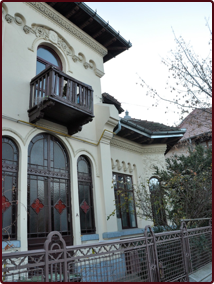
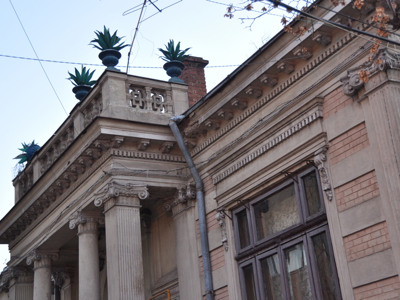
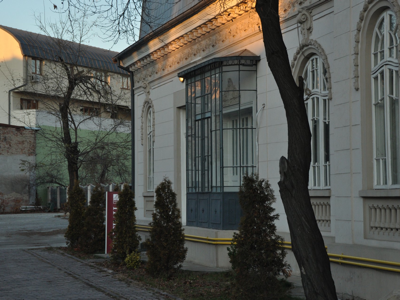
There are no museums, palaces or major sights that would draw one to this quarter lying East of the central Piața Unirii. It however preserves a quite extensive slice of late 19th century and early 20th century Bucharest.
With a maze of winding streets bordered by properties set in different styles, from the Neoclassical and Neogothic all the way to the Neoromanian ones, this part of town is a great place to walk on a hot summer afternoon. The quarter starts at the North - South Calea Traian and goes all the way to Mântuleasa Street to the West, bordered by the Calea Călărașilor to the South and Carol I Avenue to the North.
What to see: the landmarks that define it are the Hala Traian, St. Stephen Church and Square, as well as the playing children crowded Dabija Square.
Having a bite: get some supplies in Piața Traian (some covrigi should do), or at the end of the walk, from the Mântuleasa, you can go to either the Rossetya along the Hristo Botev, or to the excellent Nicorești along the Toamnei. And then, the walk passes by the Green Tea and its serene garden...
Duration: 2 hours
Note: the walk can be combined with the Romulus and Remus or the Delea Veche - Popa Nan ones.
The area was set around the mahalas (En. old calling for a small residential quarter usually set around a church or monastery) of Mântuleasa and Popa Soare; it used to continue to the E with the Popa Nan and Delea Nouă mahalas. The two mahalas developed at the end of the 17th century and the beginning of the 18th century. At that time, the city used to end here and this was the leafy garden and orchard part of town where rich merchants set their residence.
The walk: start at Piața Traian; to get there, take tramway number 40 or 56 from Piața Sfânta Vineri to the back of Unirea Shopping Centre, or the same tramways from Piața Muncii Metro Stop. Just off the square there is the yellow structure of the Hala Traian. The structure was opened in November 1896, being built after Architect Giulio Magni’s plans; initially it was meant to host different merchants and had a special section for lamb butchers. It has been beautifully restored and it nowadays hosts a supermarket. It is well worth a visit especially if interested in the European industrial architecture of the time. The area around Piața Traian is very busy with many small shops and a noisy crowd (do not miss the chance to get a hot covrig at the bakery across the square from the Hala Traian), but once one starts to the North-West of it, it suddenly changes.
Walk to the back of the Hala Traian and turn left around it (to the West just behind it), along Mihail Georgescu Street, passing by fine properties, and then take a right along the Dr. Bughelea, soon passing by the leafy
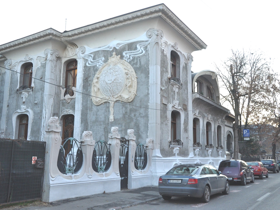
Green Tea Teahouse, with some interesting properties across the street. From here on to the North and West there are many streets bordered by fine houses set in different styles, so one might just walk at random and explore the area at leisure. Up the Dr. Burghelea, after passing by the 1744 Popa Soare Church and a couple of embassies, the street pops into Dabija Square and Popa Soare Park. To the South the square is bordered by some a fine house set in Neo-Romanian style. Continuing to the North and taking a left along the Dimitrie Racoviță, one will soon notice a beautiful property to the left, set in Art Nouveau style. They are still working on its restoration, completing the old structure with new elements (December 2011), but it would very well be featured in
Jugend. Take your time to admire the window frames, the large blazon featuring the founder’s initials, as well as the great forged iron fence decorations including the gate with its two fire - spitting dragons.
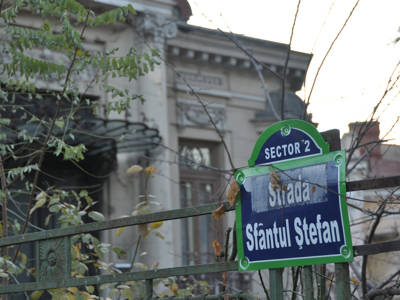
From Dabija Square one can return to the South along Sfântul Ștefan Street, which is bordered by buildings set in Modernist and Neoclassical style. The street eventually pops into Sfântul Ștefan Square, set in 1842 and sandwiching a small park on its NE side. The square meets the Calea Călărașilor Street to the South and the 1764 St. Stephen Church lies immediately to the West. The church has some interesting medallions on the outside, featuring frescoes of St. Stephen, John the Baptist, Apostles Peter and Paul, Virgin Mary, but also the Delphic and Persian sibyls and philosophers Aristotle and Plato depicted as Christian Orthodox saints.
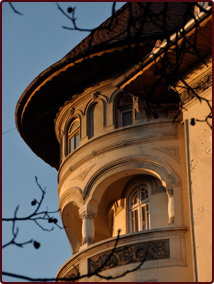
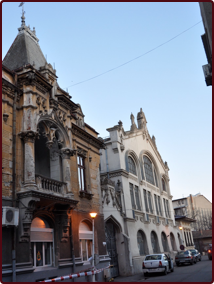
One can continue to the West along the Calea Călărașilor or go back up to the Popa Soare crossing, which continues Westwards with fine period properties. Either way, the next North - South street is the Romulus (a walk along the Romulus stretch South of the Calea Călărașilor is described here), and the stretch between Mântuleasa and Calea Călărașilor streets hosts several exquisite houses set in Neoclassical style, but also two excellent Neogothic facades set next to one another. The walk can end back at Piața Unirii, or can continue to the South of the Calea Călărașilor, along the Romulus or Remus or the streets between them, which are also bordered by fine old houses.
Another option takes one to the NW along the Mântuleasa, bordered mostly by Modernist style high rises (for this area) and centered by the 1733 church with the same name, raised by Merchant Mantu and his sister. The story goes that Mantu had an orchard in this part of town. Lady Maria, his widow, had it surrounded by a willow branch fence upon his death. However, as stray dogs roamed across the quarter, people crossing it at night used to take branches off the fence to keep dogs at bay. Dogs at bay or not, the fence was soon gone and the early 20th century saying that ‘one took something off Mântuleasa’s fence’ stood for his taking / gaining nothing (or losing everything).
Mircea Eliade. Writer, historian of religion and philosopher Mircea Eliade studied at the school on this street between 1914 and 1917 (the school no longer exists, but Eliade’s statue lies in a small park centering the street). As he greatly enjoyed walking along this street that hosted many liberal professionals at the time. Two of his short stories, ‘La țigănci’ (En. ‘With the Gypsy Girls’, 1960 for the original and 1981 for the English version) and ‘Pe Strada Mântuleasa’ (En. ‘The Old Man and the Bureaucrats’, 1967 for the original and 1979 for the English version) feature the street, focusing on its mysterious, other world atmosphere.
At the Northern tip, the street meets Carol I Avenue and the Calea Moșilor, with the options of continuing through the fine Silvestru - Popa Petre District with its great Melic House across the Carol I and then, after a recommended lunch at the Nicorești, farther through Icoanei District. Otherwise, a short trolleybus (#70, 92 and 66) ride takes one to University Square in a few minutes.